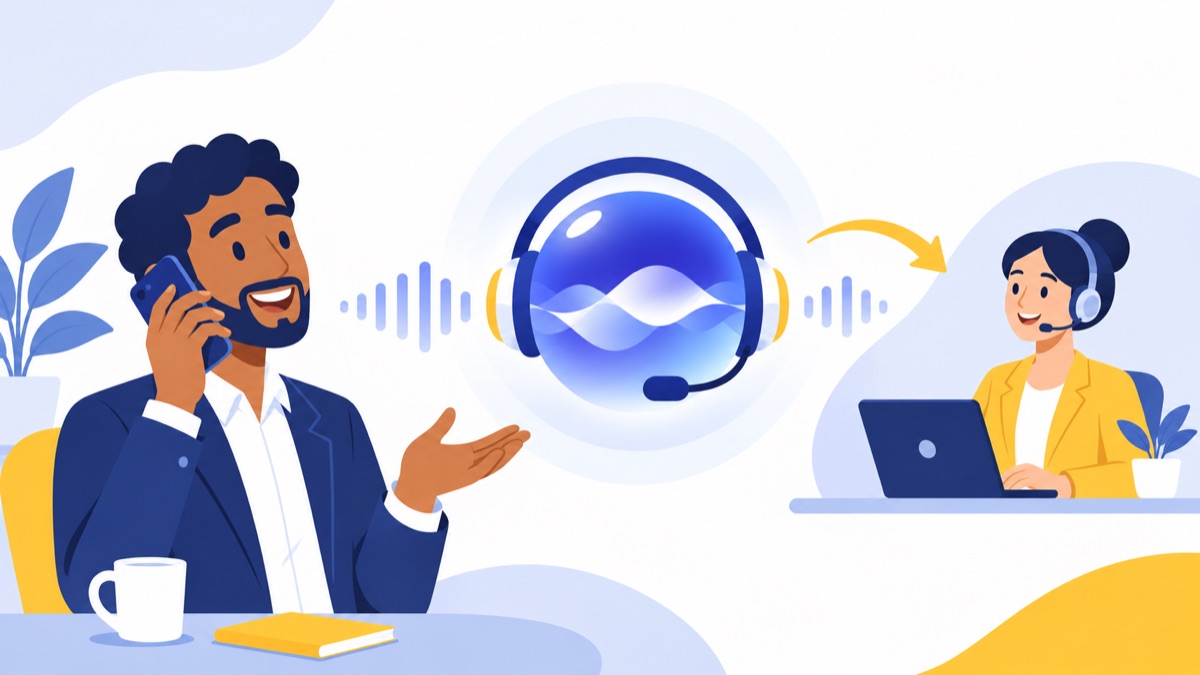
Voice agents AI can answer business calls, handle routine questions, qualify leads, and route callers to the right person. For a small or midsize US team, the practical question is whether a voice agent can complete one repeatable task accurately and hand off the rest with context. This guide explains how the technology works, what to evaluate, and how to roll it out without disrupting callers.
Key takeaways
- An AI voice agent listens, responds conversationally, and can take approved actions such as capturing lead details or routing a call.
- A reliable voice agent needs speech recognition, response generation, speech synthesis, telephony, integrations, and a clear human-transfer path.
- Inbound FAQs and lead qualification are often easier to scope than outbound sales calls, which require closer attention to consent and calling rules.
- A pilot should track task completion, transfers, abandoned calls, accuracy, and caller feedback before expanding to more call types.
- The FCC says TCPA restrictions on artificial or prerecorded voice calls include AI-generated human voices; covered outbound calls generally require prior express consent unless an exception applies.
What are AI voice agents?
AI voice agents are software systems that speak with callers, interpret what they say, and complete a defined set of tasks. Unlike a recorded prompt that only offers menu choices, an agent can answer questions in natural language, gather information, and take approved actions such as routing a call or updating a record.
A plain-English definition
An AI voice agent is a software-based call handler that listens to spoken words, determines what the caller needs, responds out loud, and may use connected business tools. Its scope should be explicit: for example, it may confirm an appointment or collect a caller’s name and reason for calling, but not change a refund policy.
AI voice agents vs. IVR, voice assistants, chatbots, and live agents
An interactive voice response (IVR) system guides callers through prerecorded prompts or menu options, such as “press 1 for sales.” A voice agent can let callers describe what they need in their own words and respond to that request. The Bureau of Labor Statistics lists IVR among self-service options for simple customer tasks.
A general-purpose voice assistant answers broad questions or performs personal tasks. A business voice agent is configured around a company’s services and workflows. A chatbot communicates by text; a voice agent handles spoken conversation over a phone or voice channel. Human-assisted AI supports an employee during a call, while an autonomous voice agent speaks directly with the caller.
How do AI voice agents work on a phone call?
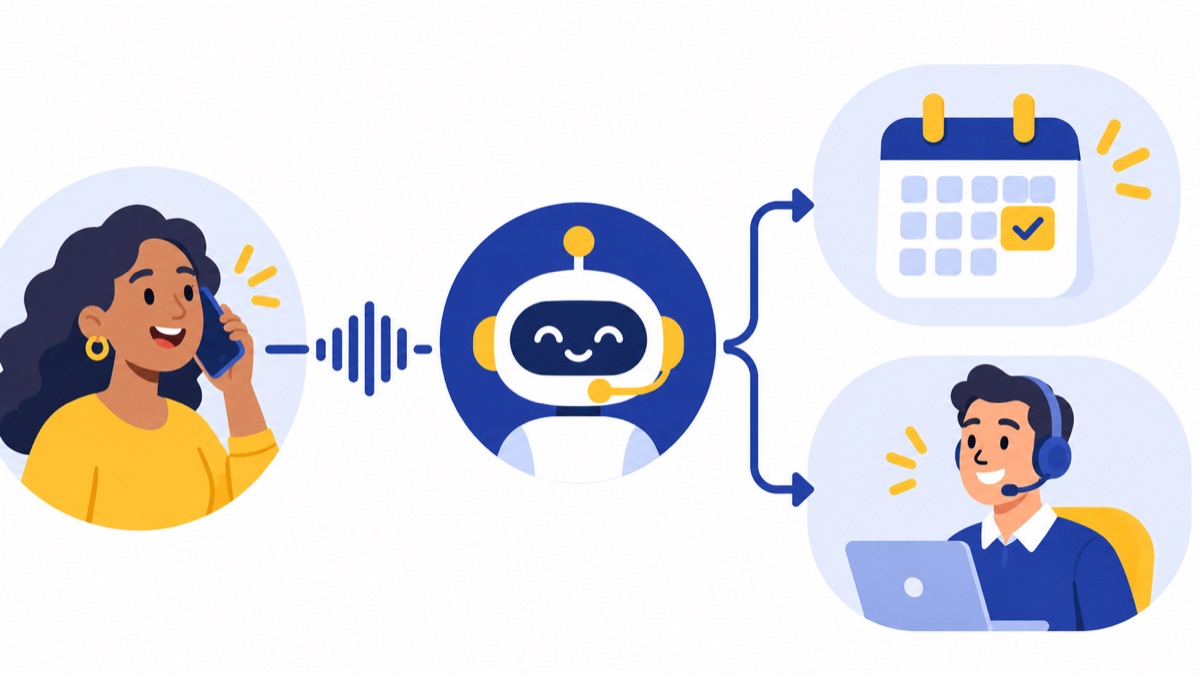
An AI voice agent turns incoming audio into text, interprets the caller’s request and conversation context, generates a response, and converts that response into speech. During the call, telephony connects the agent to the caller, and approved integrations can pass information to a CRM or trigger actions; call routing determines whether the agent continues or transfers the caller.
From spoken words to intent and response
The basic call flow has several stages:
- Speech recognition converts the caller’s audio into words.
- Intent and context handling identifies the request and uses relevant earlier turns in the conversation.
- Response generation creates a reply based on the agent’s instructions and approved information.
- Speech synthesis turns the reply into audio.
- Tool actions can look up or record information when a connected system allows it.
The experience depends on more than a natural-sounding voice. Noisy audio, accents, interruptions, long pauses, or an unexpected question can break the conversation, so the agent needs a fallback such as asking the caller to repeat themselves or transferring to staff.
Connecting the agent to business tools
An integration connects the voice agent to another system, such as a CRM, scheduling app, or order database. Give the agent only the access it needs: a lead-qualification agent may add a note and create a follow-up task, while a payment or account-change workflow may need stricter controls and human approval.
Routing or transferring the call
A transfer sends the caller from the agent to a person, queue, or voicemail. A useful handoff includes the caller’s stated need, answers already given, details collected, and any action attempted. That context helps the employee continue the conversation without asking the caller to start over.
What can businesses use AI voice agents for?
Businesses can use voice agents to handle a bounded set of inbound or outbound call tasks, but each direction has different requirements. Inbound FAQs and lead qualification can reduce routine handling when the answers are well defined; outbound follow-up and reminders need careful list, consent, timing, and escalation controls.
Inbound calls: answering, routing, and lead qualification
A support team might use an agent to give business hours, explain how to prepare for an appointment, or route a billing question to the right queue. A sales team could collect a caller’s company size, requested service, and preferred callback time before transferring a qualified lead to a representative.
Keep answers grounded in approved material and set a clear “I don’t know” behavior. If the agent cannot answer confidently, it should transfer the call or offer another next step instead of improvising.
Outbound calls: reminders, follow-ups, and outreach
Appointment reminders and requested follow-ups are narrower than cold sales outreach: they can be tied to a known event or prior request, with a defined purpose and escalation path. A voice agent might confirm whether someone plans to attend and offer to connect them with staff to reschedule.
Outbound outreach deserves extra caution. Determine which rules apply to the purpose, number, technology, consent, timing, and recipient before making calls; do not assume that an existing customer relationship automatically permits every type of automated call.
When should an AI voice agent transfer a call to a human?
A voice agent should transfer a call when a caller asks for a person, the agent fails to understand after a reasonable retry, the request falls outside its approved scope, or the issue is sensitive or emotionally charged. Set transfer triggers in advance and send the receiving employee the conversation summary and any details the caller has already provided.
How do you choose an AI voice agent or platform?
Choose a platform by testing whether it can complete your actual call task reliably and work with your phone setup, staff, and records. Compare latency, interruption handling, accuracy, languages, integrations, call volume, analytics, security, uptime commitments, and human transfer; a vendor feature list alone does not show how the system performs on your calls.
Conversation quality and reliability
Test with real-world variations: callers who interrupt, speak quickly, use different accents, call from a noisy location, or ask an unlisted question. Check how quickly the agent responds, whether callers can interrupt it naturally, and whether it admits uncertainty instead of giving an unsupported answer.
Ask what happens when a speech or CRM service is unavailable. A safe design should still offer a fallback—such as routing to staff, taking a voicemail, or providing an alternate contact method—instead of leaving the caller in silence.
Telephony, CRM, and workflow integrations
Confirm that the system supports your call direction, phone numbers, business hours, queues, transfers, and existing CRM. Ask whether it can pass context to a live employee and record the outcome, and test that workflow end to end before relying on it.
There are two broad buying paths. Developer platforms provide APIs and building blocks for a company or implementation partner to assemble and maintain an agent. Business-ready phone and contact-center systems package more of the call routing and administration, though capabilities vary and should be verified in a live trial.
For background on how phone numbers support these workflows, read the guide to voice agents, AI, and VoIP numbers. If the team needs a basic overview of business calling options, see what VoIP services include.
Pricing, analytics, and security
Ask for a total-cost estimate that includes telephony, model usage, setup, integration, monitoring, support, and human escalation. A low per-minute rate can be misleading if calls run longer than expected, require retries, or still need staff to finish the task.
Review analytics for task completion, transfers, abandonment, call duration, and errors. Ask how call audio and transcripts are stored, who can access them, how long they are retained, and what security controls and reliability commitments apply.
How do you roll out an AI voice agent without disrupting callers?
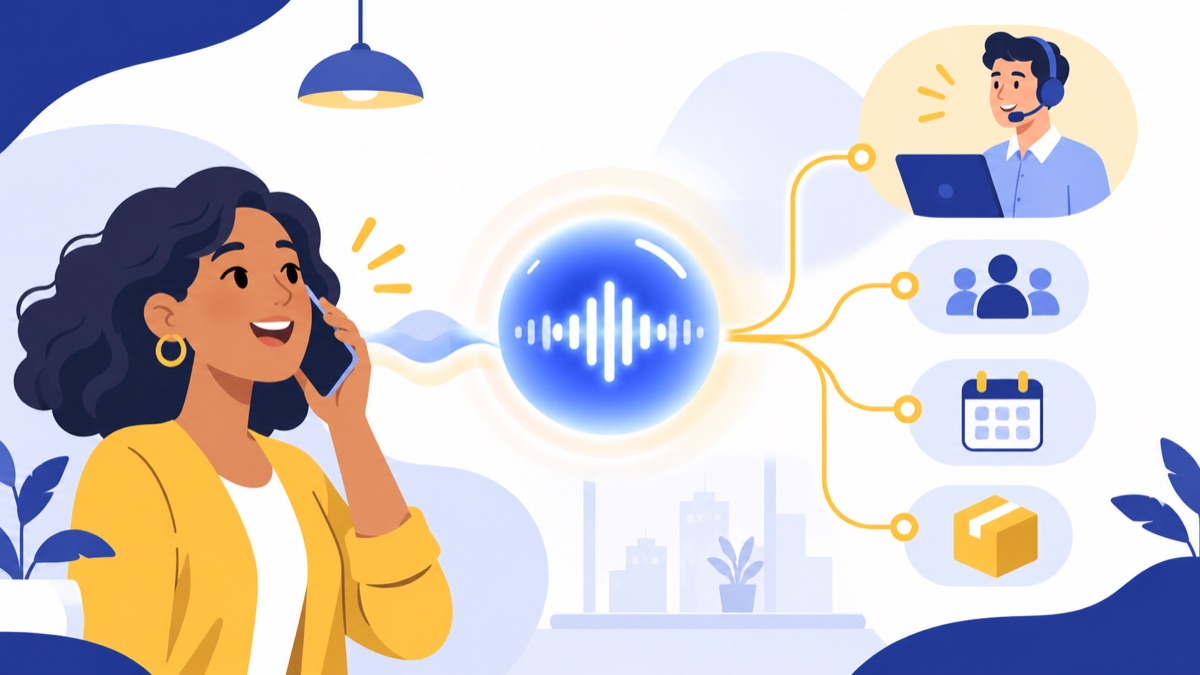
Roll out an AI voice agent in a controlled pilot focused on one frequent, low-risk task with a measurable outcome. Before connecting it to callers, test realistic conversations and failure cases, define how callers reach a person, and monitor both task results and customer experience; expand only when the pilot meets your standards.
Start with one narrow, measurable task
Pick a workflow with predictable questions and a clear finish line, such as confirming an appointment or collecting the reason for a sales callback. Write down what the agent may say, what information it may collect, which actions it may take, and when it must stop and transfer.
Choose a baseline from your current process. For example, count how many calls of that type arrive each week, how many are resolved on the first contact, and how often callers need a transfer.
Test edge cases and handoffs
Before launch, run scenarios covering:
- A clear request, a vague request, and a question outside the agent’s scope.
- Background noise, interruptions, silence, and a caller changing their mind.
- A CRM lookup that returns no result or an integration that fails.
- A caller who requests a person or becomes frustrated.
- A transfer during and outside business hours.
Check whether the agent gets names, dates, and phone numbers right, follows approved answers, and preserves context when it transfers the call. Have a person review the results and fix unsafe responses or broken routing before expanding access.
Monitor results and expand carefully
During the pilot, review calls regularly and track task completion, transfer rate, abandonment, retries, errors, and caller feedback. A rising transfer rate may mean the agent’s scope is too broad, while a high completion rate is not enough if callers are frustrated or receive incorrect answers.
Expand one call type at a time. Recheck scripts, integrations, staffing, and escalation paths after each change, and pause a workflow if its accuracy or caller experience falls below your agreed threshold.
Are AI voice agents legal for outbound calls in the United States?
AI voice agents may be used for outbound calls, but US calling rules can require consent and may vary with the call’s purpose and technology. The FCC has ruled that TCPA restrictions on artificial or prerecorded voice calls include AI-generated human voices; for covered calls, prior express consent is generally required unless an exception applies.
Consent and AI-generated outbound calls
The FCC’s 2024 ruling treats AI-generated human voices as “artificial or prerecorded voice” under the Telephone Consumer Protection Act (TCPA). The consent needed can depend on the call’s purpose and circumstances, and exceptions may apply. Check current FCC requirements and applicable state rules with counsel before launching an outbound campaign; this overview is general information, not legal advice.
Transparency, privacy, and recordkeeping
Decide what callers should be told about speaking with an automated system and how to reach a person. Minimize the personal information the agent collects, limit access to recordings and transcripts, define retention periods, and document consent and call outcomes where applicable.
How do voice agents fit into a business phone system?
A voice agent is one part of a phone workflow: the business still needs numbers, business-hour rules, queues, voicemail, staff routing, and follow-up records. When the agent cannot finish a task, the rest of the phone system should make the next step clear for both the caller and the employee.
Numbers, menus, queues, voicemail, and live teams
A call may arrive on a business number, enter an existing menu, reach the agent for a specific task, and then route to a sales or support queue. If no one is available, a caller should have a useful alternative, such as leaving a voicemail or requesting a callback.
Teams that want to improve the surrounding workflow can review Voicalyst’s virtual phone system, IVR menus and call routing, and voicemail transcription. These tools can support the workflow around an agent; this article does not claim that Voicalyst provides autonomous voice agents.
Call summaries, CRM sync, and follow-up
A useful call record captures what the caller needed, what the agent or employee did, and what follow-up remains. With appropriate controls, summaries can help employees review calls, while CRM integrations can associate outcomes with the right contact.
Voicalyst’s AI call summaries can help teams review call outcomes and follow-up needs. For more on the relationship between AI agents and phone systems, see the guide to connecting voice agents with VoIP numbers.
Frequently Asked Questions
How much do AI voice agents cost?
AI voice agent costs include more than minutes: budget for telephony, model usage, setup, integrations, monitoring, support, and calls transferred to staff. Ask vendors to price your expected monthly call volume and show what happens when calls run long, need retries, or require a human. Compare total cost per successfully completed task, not just the advertised rate.
Are AI voice agents legal for business calls?
AI voice agents can be used for business calls, but outbound calls using AI-generated or prerecorded voices may be subject to TCPA consent rules. The FCC says restrictions on artificial or prerecorded voice calls include AI-generated human voices. Requirements depend on the call and may include exceptions; state rules can add obligations, so consult counsel about your use case.
Will AI voice agents replace human agents?
AI voice agents are best suited to scoped, repeatable tasks such as answering basic questions, collecting lead details, or routing calls. People remain important for exceptions, sensitive issues, negotiations, and emotionally charged conversations. Define transfer triggers and pass the caller’s request, collected details, and actions already taken to the human.
How do I know if my business is ready for an AI voice agent?
Your business is a better candidate when one call type is frequent, predictable, easy to measure, and has a clear owner. Review real calls, document approved answers and actions, and confirm your phone system can transfer callers to staff. If answers, policies, or ownership are unclear, standardize those first.