
A ring group offers an incoming call to a set of people; a call queue keeps the caller waiting until an agent is available. For a small business, the choice depends on whether calls overlap, whether callers should wait for a person, and who will follow up on unanswered calls. Use the comparison and example flows below to match your routing to your actual call patterns.
Key takeaways
- A ring group can ring several phones at once or in sequence, and its busy-call behavior depends on the phone system’s settings.
- A call queue holds callers for available agents; greetings, wait announcements, callbacks, and overflow depend on the system and configuration.
- Choose routing based on peak-hour concurrent calls, caller expectations, and follow-up ownership rather than a universal team-size cutoff.
- Ring groups and queues can work together when the main line and a sales or support department need different call handling.
Ring group vs. call queue: what’s the difference?
A ring group offers a call to selected team members, while a call queue holds the caller until an agent can take it. A ring group suits informal shared coverage when someone can answer promptly; a queue suits situations where calls overlap and callers need an organized wait, fallback, or follow-up path.
The difference in one sentence
A ring group is a routing setup that rings a defined set of phones. A call queue is a setup that holds and distributes calls to available agents according to configured rules.
“Call queue vs ring group” is not simply a choice between a small and a large team. Consider how many callers arrive while staff are busy, what the caller should hear, and whether you need to track abandoned calls and callbacks.
A quick rule for choosing
Use a ring group if calls are occasional and the team can share them without a formal waiting process. Use a queue if callers should stay in line for an available person, or if the business needs visibility into waits and abandoned callers.
If you are unsure, review call activity during the busiest hours. Count overlapping calls, unanswered calls, voicemails, and repeat callers, then compare that pattern with the caller experience you want to provide.
What does a ring group do?
A ring group routes an incoming call to multiple team members, either at the same time or in a configured order. The first person who answers generally takes the call, but rules for busy phones, timeouts, and fallback destinations vary by phone system.
Simultaneous ring and sequential ring
With simultaneous ring, phones in the group ring at once. With sequential ring, the system tries one member, then another if the first person does not answer within the configured time.
A hunt group is a term for a system that searches a set of extensions or agents according to routing rules. Some providers use it interchangeably with ring group; others use it for a specific routing pattern. Confirm whether the feature rings members together or hunts through them in sequence. For a closer comparison, see this ring group vs. hunt group setup guide.
What happens when nobody answers?
After a timeout, a ring group may send the call to voicemail, another group, an overflow number, or a queue. If every member is busy when a call arrives, the system may treat those people as unavailable or apply a separate busy-call rule. The business should confirm both behaviors before going live.
Simultaneous ringing can help a small team share occasional calls. But if another caller arrives while everyone is on a call, that caller needs a defined next step; otherwise, they may hear ringing without knowing whether anyone will answer. For rules around forwarding and ring order, see business call forwarding options.
What does a call queue do?
A call queue holds callers until an agent is available, then offers calls according to a fixed or rules-based distribution method. Queues can support wait audio, announcements, callbacks, and overflow, but those are product capabilities and configuration choices—not automatic features of every queue.
How callers wait for an available agent
Callers may hear a greeting and hold audio while agents finish other calls. Depending on the phone system, the queue may announce the caller’s position or estimated wait, offer a callback, or route callers to another destination.
A queue also needs an operating owner: someone who checks coverage, handles breaks, and reviews callers who leave before an agent answers. Queue message scripts and timing can help set expectations while callers wait.
Wait limits, callbacks, and overflow
Set a maximum wait or another clear exit condition. When that limit is reached, a queue might offer a callback, send the caller to voicemail, route the call to another team, or end the wait with instructions for another contact path.
Callbacks can help when callers prefer not to stay on hold, but a callback needs an owner and a process. Decide who returns it, how quickly, and where the task is recorded. For practical ways to reduce delays, review nine fixes for long call waits.
Ring group vs. call queue: decision table
A ring group generally offers direct ringing with a simple timeout, while a queue gives callers a defined wait for available agents. Which feels better to the caller depends on whether the business can answer quickly, how long the caller may wait, and whether a useful fallback is configured.
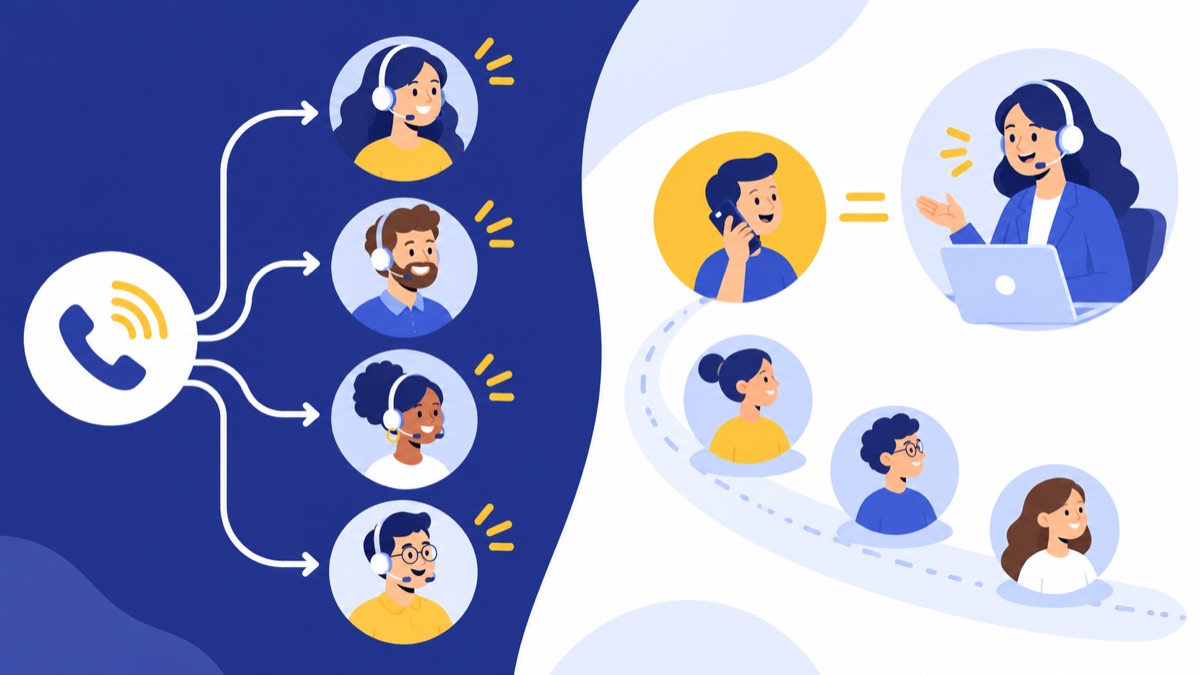
| Decision factor | Ring group | Call queue |
|---|---|---|
| Who receives the call? | Selected members ring at once or in sequence. | Available agents receive calls according to queue rules. |
| What does the caller hear? | Usually ringing until answer or timeout; fallback audio depends on configuration. | Often a greeting or hold audio; announcements depend on system and settings. |
| What if everyone is busy? | Caller may reach voicemail, another destination, or a queue—or keep ringing until timeout. | Caller may wait, request a callback, reach overflow, or leave; rules vary. |
| What staffing is needed? | Team members need to know who is covering and what happens when they are unavailable. | Someone needs to monitor coverage, breaks, wait limits, and follow-up. |
| What can the business measure? | Often unanswered calls and voicemails, depending on reporting. | May include queue wait and abandonment, depending on reporting. |
| What is the typical fallback? | Voicemail, overflow number, another group, or queue. | Callback, voicemail, another queue or group, or overflow destination. |
“Missed” can describe different outcomes. A missed call is a call that was not answered; a voicemail is a message the caller left; and an abandoned call is one where the caller hung up before reaching an agent. Systems report these outcomes differently, so check what your call records actually show.
How should you choose for your call volume and team?
Choose a ring group when calls are occasional and shared coverage works; choose a queue when concurrent calls are common or callers should wait for an agent. Before changing routing, review peak-hour overlap, unanswered calls, repeat callers, business hours, and who owns callbacks so the setup fits real operations.
Choose a ring group when calls are occasional
A ring group can work well for a general business line when several people can answer and callers do not need a formal place in line. Set the ring order, timeout, and fallback destination, and name someone responsible for checking any resulting voicemail or missed calls.
Choose a queue when callers should wait
A queue can fit sales or support lines where staff are often already speaking with callers. It gives the business a way to define what callers hear and where they go if the wait gets too long. Queue-level reporting can also help identify busy periods and abandoned callers when the system provides those measures.
Published benchmarks offer context, not a target for an individual business. In ContactBabel’s 2025 US Contact Center Decision-Makers’ Guide, surveyed organizations reported an average speed to answer of 99 seconds and call abandonment of 8.9%. Large contact-center results do not predict what a small business should expect.
Use both when lines need different handling
A main number can start with a phone menu, then route general inquiries to a ring group and sales or support callers to a queue. Voicalyst’s phone menus and call routing can support this kind of routing; voicemail, AI call summaries, or HubSpot sync may help with follow-up when they fit the workflow.
Do not add queue steps simply because the feature exists. Choose a route callers can understand, test what happens when the team is busy, and assign a person to every voicemail, callback, and overflow path.
What do two practical call flows look like?
A useful call flow names what happens at every branch, including when nobody answers or a caller reaches a wait limit. The examples below show a small-business ring group for shared coverage and a department queue for calls that may arrive while staff are busy.
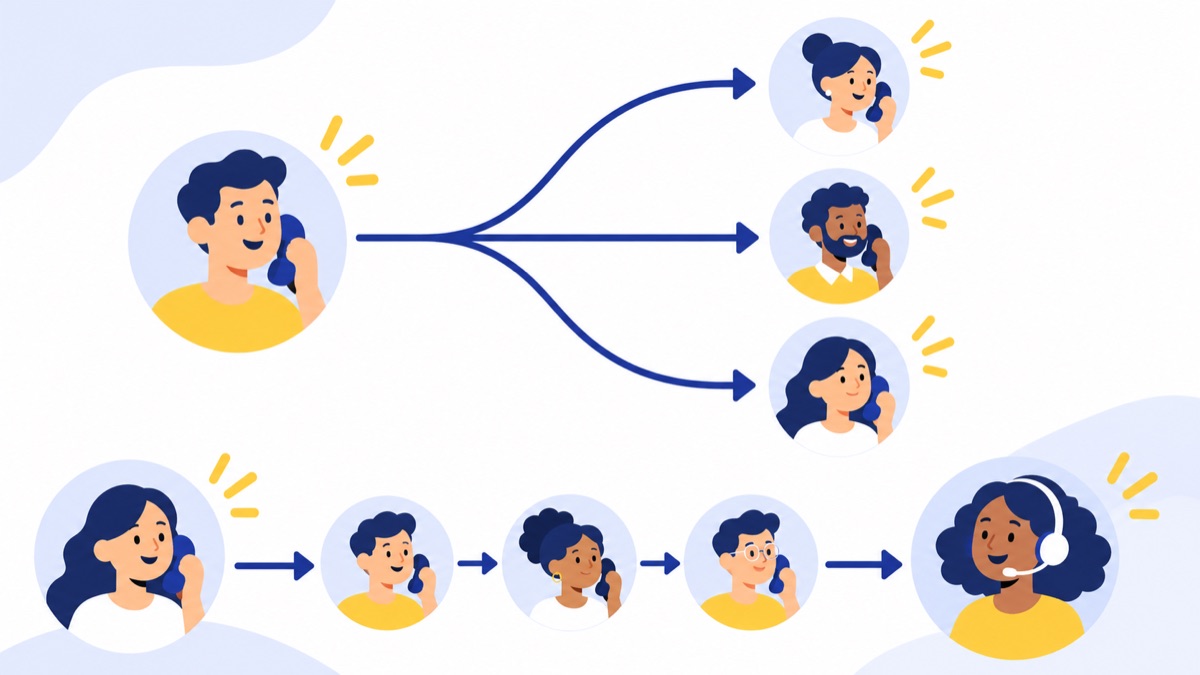
Small business: main line to a ring group
- Caller dials the business number. The caller hears a short greeting or rings through, depending on the setup.
- Three teammates’ phones ring. Use simultaneous ringing for shared coverage, or sequential ringing if the business wants one person to have first chance.
- A teammate answers. The call leaves the group and the conversation begins.
- Nobody answers before the timeout. Route the caller to voicemail or an overflow destination, such as a backup team or queue.
- A named person checks the fallback. Assign voicemail or missed-call follow-up to a specific role, and decide when the team will return the call.
Sales or support: phone menu to a queue
- Caller reaches the business number and hears a menu. The menu directs the caller to sales or support.
- The selected department queue checks for an available agent. If someone is free, the system offers the call.
- All agents are busy. The caller hears the configured greeting or hold audio and, if supported and enabled, an estimated wait or callback option.
- The wait limit is reached. Offer a callback, send the caller to voicemail, or overflow to another destination.
- The queue owner reviews the outcome. Assign abandoned-call and voicemail follow-up, record callbacks, and check that completed follow-ups are marked.
For configuration details by routing strategy, use this call queue setup guide.
What should you measure after setup?
Track unanswered calls and voicemails for a ring group, and queue waits and abandoned callers for a queue when your system reports them. Review results during peak hours as well as across the full week, then adjust the routing and follow-up process where callers are repeatedly lost.
Compare the before-and-after pattern using the same time periods. Check whether concurrent calls lead to more voicemail, whether wait limits are sending callers to a useful destination, and whether assigned callbacks are actually completed.
A 2024 customer-service survey reported that 39% of respondents would wait up to five minutes before becoming frustrated or angry, and 75% preferred a callback when it was their turn over a long hold. Those survey findings can inform questions to ask about caller experience; they are not a promise about your customers.
Michigan’s Office of the Auditor General reported a 10.1% abandoned-call rate for the state Department of State call center between October 2024 and April 2025. The report also counted 10,457 calls abandoned after five minutes or more. These public-sector figures illustrate why it helps to set wait limits and fallback plans, but they are not a small-business benchmark.
Frequently Asked Questions
Can a ring group and a call queue work together?
Yes. A main number or phone menu can route callers to a ring group for general calls and to a department queue for sales or support. Set a clear fallback for each path—for example, send unanswered ring-group calls to voicemail or a queue, and send callers who reach a queue’s wait limit to callback or voicemail. Available options depend on your phone system.
Is a hunt group the same as a ring group?
The terms overlap, but providers do not use them uniformly. A ring group usually describes a set of people whose phones ring together or in a configured order. Hunt group often describes a system that searches through extensions or agents according to routing rules. Check whether the specific system supports simultaneous ringing, sequential ringing, or both.
What happens if everyone in a ring group is busy?
The phone system may send the caller to voicemail, another group, a queue, or an overflow number, or it may keep ringing until a timeout. Some systems treat busy agents as unavailable; others may allow call waiting or another call. Confirm the busy-call rule and test it with a live call before relying on the setup.
Do callers hear ringing or hold music in a call queue?
Callers commonly hear a greeting or hold audio while the system keeps them in a queue, but the exact experience depends on the phone system and its settings. Some queues can announce position or estimated wait, offer a callback, or route callers elsewhere after a wait limit. These features are not guaranteed in every queue.
How can a small business reduce missed calls?
Review peak-hour concurrency and identify where calls currently go unanswered, reach voicemail, or are abandoned. Configure a ring group or queue with a tested fallback, assign an owner to return voicemails and callbacks, and review the results regularly. A Voicalyst phone system can connect browser-based calling, menus, queues, voicemail, AI call summaries, and HubSpot sync where those tools fit your workflow.