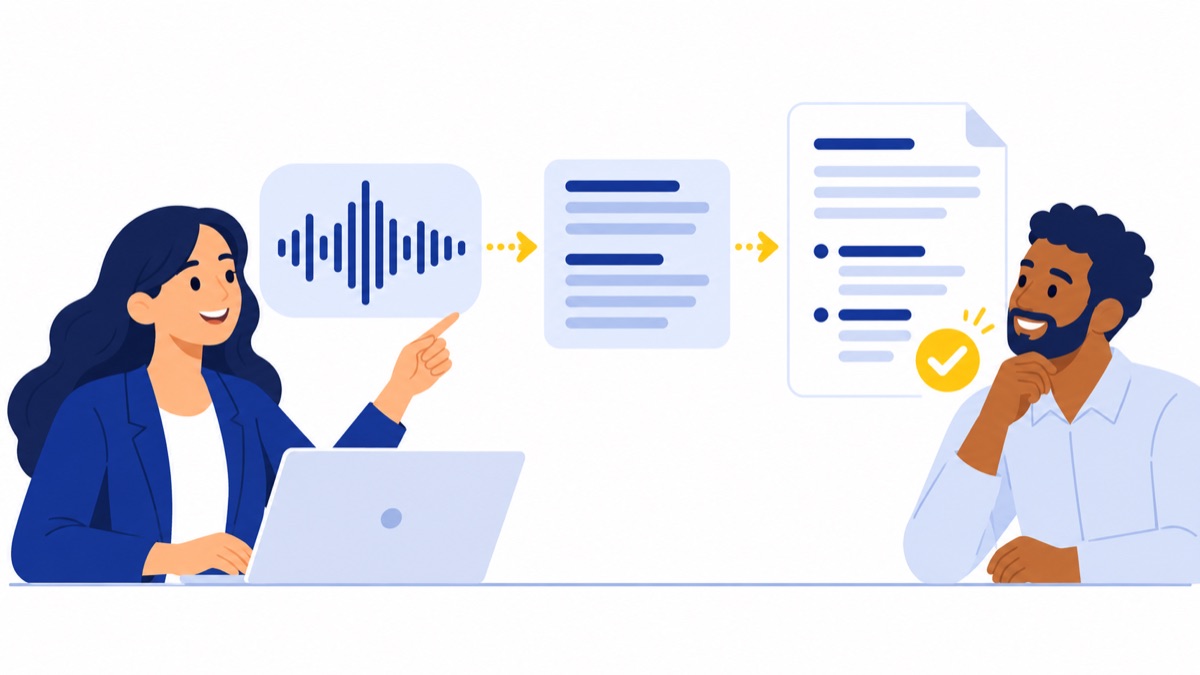
AI call transcription accuracy varies by tool and call conditions; there is no universal percentage, and a benchmark on clean meeting audio may not predict results on your business phone calls. To estimate how well a tool will work for your team, test representative, consented calls against human-checked transcripts, and score summaries separately for factual accuracy and omissions.
Key takeaways
- AI call transcription accuracy depends on the model, phone audio, speakers, and vocabulary, so a published score is not a guarantee for your calls.
- Word error rate (WER) counts substitutions, deletions, and insertions; NIST defines WER as their sum divided by the number of words in the reference transcript.
- Transcript quality and summary quality are separate: an understandable transcript can still produce an incomplete or misleading summary.
- A useful business pilot scores WER alongside names, numbers, speaker labels, commitments, action items, and summary omissions.
- Human review is especially important for CRM fields and records that contain prices, dates, customer commitments, or assigned follow-ups.
How accurate are AI-generated call transcripts and summaries?
AI call transcription accuracy varies with the recognition model, audio conditions, speakers, and vocabulary, so no single percentage describes every tool or business call. A transcript and its summary also need separate checks: word recognition measures what was said, while summary review checks whether the right facts and actions were captured.
The short answer: accuracy depends on the tool and the call
A score from a quiet, clearly recorded meeting may not reflect a sales call over a mobile connection, with interruptions and unfamiliar product names. For a useful estimate, test the calls your team actually handles, including routine and difficult examples.
Why there is no single accuracy percentage
Published results depend on the dataset, recording conditions, language, scoring rules, and test date. Models change, and a clean sample can hide problems with crosstalk, telephone audio, regional vocabulary, or speakers who talk quickly. Treat a benchmark as evidence about its test—not a forecast for your team.
What does transcription accuracy mean?
Transcription accuracy describes how closely a generated transcript matches what was spoken, but one score cannot capture every business consequence. Word error rate is a common comparison metric; speaker-label accuracy and factual checks add context for deciding whether a transcript or call record is useful.
Word error rate (WER), explained
Word error rate (WER) is the number of word substitutions, deletions, and insertions divided by the number of words in a human-checked reference transcript. NIST uses this definition in its speech recognition evaluation plan. Lower WER means fewer word-level differences.
A substitution is a recognized word that differs from the reference; a deletion is a spoken word that the transcript leaves out; an insertion is a word that appears in the transcript but not in the reference. WER can exceed 100% if there are many errors, so subtracting WER from 100% does not produce a complete measure of practical accuracy.
Why WER does not measure every business-critical error
WER treats words as units, not business risks. One incorrect digit in a callback number, a missing “not” in an approval, or a wrong price can matter more than several harmless errors elsewhere in a call. Track these details directly instead of relying on a single overall score.
Transcription accuracy versus speaker-label accuracy
Speaker diarization is the process of identifying who spoke when. A transcript can recognize the right words but assign a customer’s objection to the sales representative, or a support agent’s promise to the customer. That mistake can make ownership and intent appear reversed in a CRM record.
What makes business call transcripts less accurate?
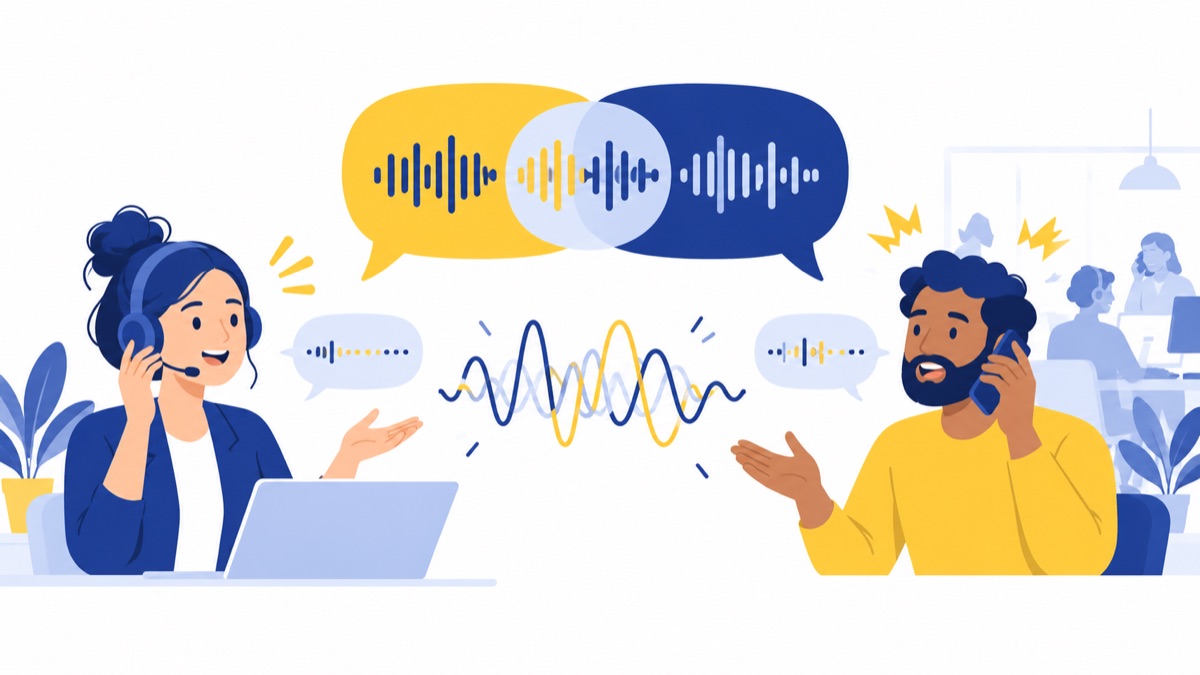
Business call transcription can be harder when speech is muffled, interrupted, fast, quiet, or full of unfamiliar words. Phone codecs, noise, accents, language changes, and overlapping speakers all affect the signal or the vocabulary a recognition system must interpret.
Phone audio, noise, and connection quality
Telephone audio may be compressed, distorted, or cut off by a weak connection. Background conversations, a loud office, road noise, or a speakerphone echo can mask consonants and short words. A system may turn a barely audible product model or account number into a plausible but incorrect phrase.
Accents, dialects, and language switching
Recognition performance can differ across speakers and language varieties. A 2020 study of five commercial speech recognition systems reported average WER of 0.35 for Black speakers and 0.19 for white speakers in the study’s data; this is dated evidence about those systems and samples, not a current universal rate. The study record is a reason to test with your actual caller population.
Language coverage matters too. The U.S. Census Bureau’s 2024 American Community Survey estimates that 23.0% of the U.S. population age five and older speaks a language other than English at home. Calls may include language switching, regional pronunciation, or English mixed with a customer’s preferred language. Test these calls where they are part of your service.
Crosstalk, interruptions, and speaking speed
People often interrupt one another to correct a detail, answer quickly, or negotiate next steps. When speech overlaps, a transcript may omit a short phrase or jumble the turn order. Fast speech and quiet responses can also make important acknowledgements or objections harder to capture.
Names, numbers, acronyms, and industry terms
Names and specialized vocabulary are frequent trouble spots because a system may not know a company’s terminology in advance. Review examples like a customer surname, SKU, insurance code, product acronym, dollar amount, callback number, and “the 14th” versus “the 40th.” Where available, configure a vocabulary list or keywords for common terms.
Why can a transcript be readable while the summary is wrong?
A readable transcript does not guarantee an accurate call summary because summarization selects and reorganizes details rather than simply reproducing every word. A summary can omit an objection, misstate a commitment, or assign an action to the wrong person, and recognition errors in the transcript can carry forward into the summary.
Errors that carry from transcript into summary
If the transcript turns “we can’t ship by Friday” into “we can ship by Friday,” a summary may repeat the false commitment. Check consequential claims against the transcript and, when needed, the recording. This matters for delivery dates, refunds, contract terms, escalations, and promises made to customers.
Omitted details, incorrect ownership, and invented context
A summary may miss a customer’s condition, such as agreeing to a quote only after a supervisor approves it. It may also label the wrong person as owner of a follow-up or add a conclusion that no speaker stated. Evaluate whether summaries preserve the call’s key facts, qualifications, and speaker attribution—not just whether they read smoothly.
How to verify action items and CRM notes
Review commitments, objections, dates, amounts, and action owners before using them in customer records. Teams comparing workflows can use the manager review workflow for AI call summaries or the call recording to CRM notes buyer’s guide to shape a practical review process.
How do published AI transcription benchmarks compare?
Published benchmarks show how systems performed on specific test sets, but their scores do not establish accuracy for every business phone call. Compare each benchmark’s dataset, audio conditions, metric, test date, and independence, then run your own pilot using similar calls and vocabulary.
What WER benchmark scores can tell you
A lower WER on a defined dataset indicates fewer word-level differences against that dataset’s references. For example, Artificial Analysis reports a 2.3% overall WER for ElevenLabs Scribe v2 in AA-WER v2. Its composite score weights a proprietary voice-agent dataset at 50%, with parliamentary and earnings-call datasets at 25% each. That mix is not a direct estimate for every business phone call.
Zoom’s 2024 AI performance report reported WER of 7.40% for Zoom, 10.16% for Webex, and 11.54% for Microsoft in its tested meeting-transcript scenarios. Those figures describe that platform-specific evaluation, not a guarantee for telephone calls.
Why meeting and voice-agent results may not predict phone-call results
Meeting recordings, voice-agent conversations, and ordinary business calls can differ in microphones, codecs, speaker turns, vocabulary, and background conditions. Zoom’s 2025 report describes tests involving meeting sizes and conditions such as accents, noise, overlapping speech, and reverberation, with normalized and rare-word WER and speaker-label accuracy. The 2025 evaluation is a useful example of measuring more than one dimension, but it was commissioned by Zoom and still does not substitute for testing your calls.
Questions to ask about a benchmark’s method
Before applying a score to your team, ask:
- What recordings and languages were included, and how many speakers or calls?
- Were the recordings real phone calls, meetings, voice-agent interactions, or clean read speech?
- Which metrics were reported: WER, rare-word WER, speaker labels, summary quality, or a combination?
- When was the test run, and who selected the samples and conducted the evaluation?
- Were results broken out by noise, accents, crosstalk, or important vocabulary?
How do you test AI call transcription accuracy for your team?
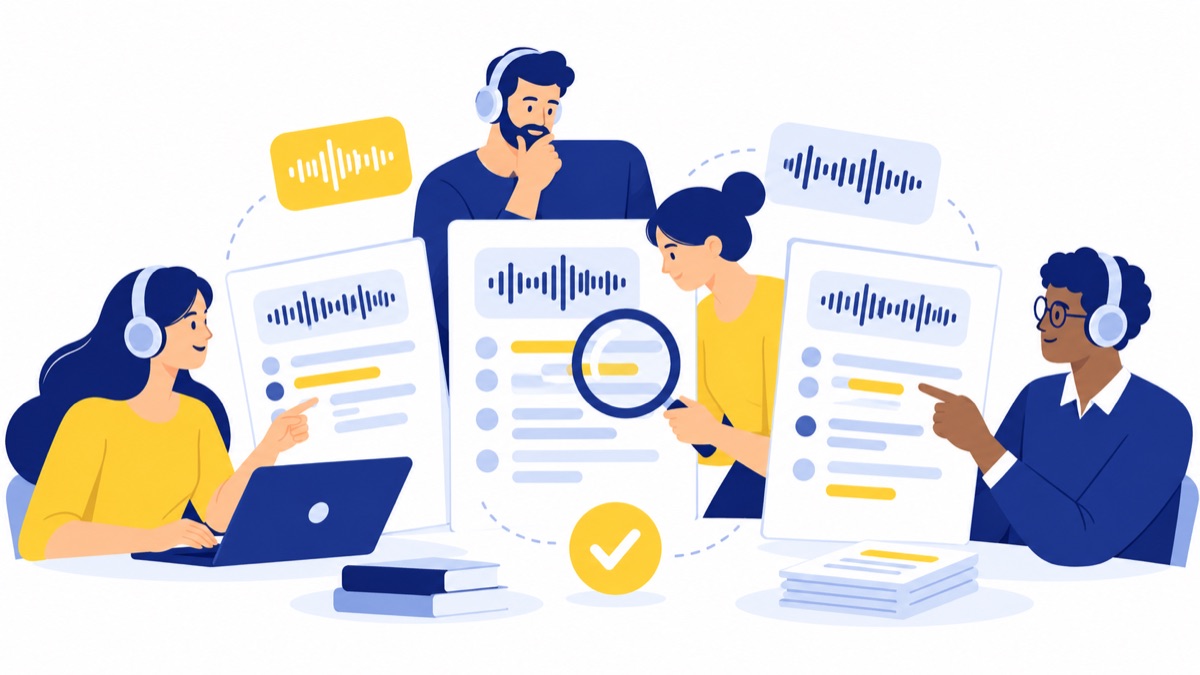
To test AI call transcription accuracy, create a varied sample of consented business calls, compare the generated output with human-checked references, and record both word-level and task-level errors. Repeat the review across call types, then decide which mistakes require a person to check a record before it reaches a customer or CRM.
Build a representative call sample
Use calls that reflect the range of your team’s work. Include sales and support calls, different caller accents and speaking speeds, mobile and headset audio, noisy settings, interruptions, and common industry terminology. Follow your organization’s consent and recording requirements.
A small pilot can start with 30 calls: 10 routine, 10 with challenging audio or overlapping speakers, and 10 rich in names, numbers, or commitments. This is a practical starting sample, not a statistically conclusive benchmark. Increase it when call types or caller populations vary widely.
Score transcripts and summaries against human-checked references
For each call, have a reviewer correct a reference transcript, then compare the system output. Track WER, but also use a checklist for:
- Customer and employee names, phone numbers, dates, prices, and account details
- Speaker labels and who made each statement
- Key facts, objections, negations, and customer commitments
- Action items, their owners, and due dates
- Summary omissions, incorrect claims, and details that do not appear in the call
Have a second reviewer check a portion of the sample to catch inconsistent reference judgments. Keep transcript scoring separate from summary scoring so a strong result in one does not hide failures in the other.
Set review rules for high-impact errors
Decide in advance which fields can flow into a CRM automatically and which need human confirmation. For example, a team might allow an editable call summary to be drafted automatically but require a rep to confirm a price, next-step date, or account change before saving it as a commitment.
How can you improve accuracy and use summaries safely?
Teams can improve their chances of getting useful transcripts by reducing avoidable audio problems, supplying vocabulary where a tool supports it, and reviewing business-critical fields. Keeping the recording available for spot checks gives staff a way to resolve ambiguous words and verify whether summaries preserve the actual conversation.
Improve audio and configure vocabulary
Encourage callers and staff to use a clear microphone, avoid speakerphone when possible, and move away from competing conversations. Where supported, add common product names, acronyms, and customer terminology to a keyword list. These steps can help, but their effect depends on the tool and call conditions.
Keep recordings available for spot checks
A transcript can make a call searchable, while the recording preserves the original evidence. Retain recordings according to your business policies and applicable requirements, and make them accessible to authorized reviewers. A call recording feature can support spot checks; use it with the consent and retention practices that apply to your organization.
Use AI summaries as drafts for important records
Treat summaries as drafts when they affect customer commitments, sales forecasts, support escalations, or CRM fields. Voicalyst offers AI call summaries and a HubSpot calling integration for teams evaluating calling and CRM workflows. Review the tool on your own calls before relying on summaries for important decisions.
For a broader comparison of selection criteria, see the guide to business phone systems with AI call summaries. Explore Voicalyst to see whether its calling and summary workflow fits your team; evaluate accuracy with the same representative-call pilot you would use for any tool.
Frequently Asked Questions
How accurate is AI call transcription?
There is no universal accuracy percentage for AI call transcription. Results depend on the speech recognition model, phone audio, background noise, speakers, accents, and vocabulary. Published benchmark scores describe specific datasets and test conditions. To estimate performance for your business, score representative, consented calls against human-checked transcripts and separately evaluate summaries.
What is a good word error rate for transcription?
A lower word error rate (WER) means fewer transcription errors, but there is no single WER that makes a transcript good for every business. WER counts substitutions, deletions, and insertions against a reference transcript; it can exceed 100%, so 100% minus WER is not a complete accuracy measure. Check names, prices, dates, negations, and speaker labels too.
Can AI call summaries make mistakes?
Yes. A summary can leave out or misstate a commitment even when the transcript is readable, and transcript errors can carry into the summary. Review important details against the transcript or recording, especially who owns a follow-up, what the customer agreed to, and any price, date, or account change.
How can I test AI transcription for my business?
Choose a varied sample of consented business calls and have people create accurate reference transcripts. Compare the tool’s transcripts using WER, then check names, numbers, speaker attribution, key facts, action items, and summary omissions. Repeat the sample and review high-impact errors before deciding which records need human approval.