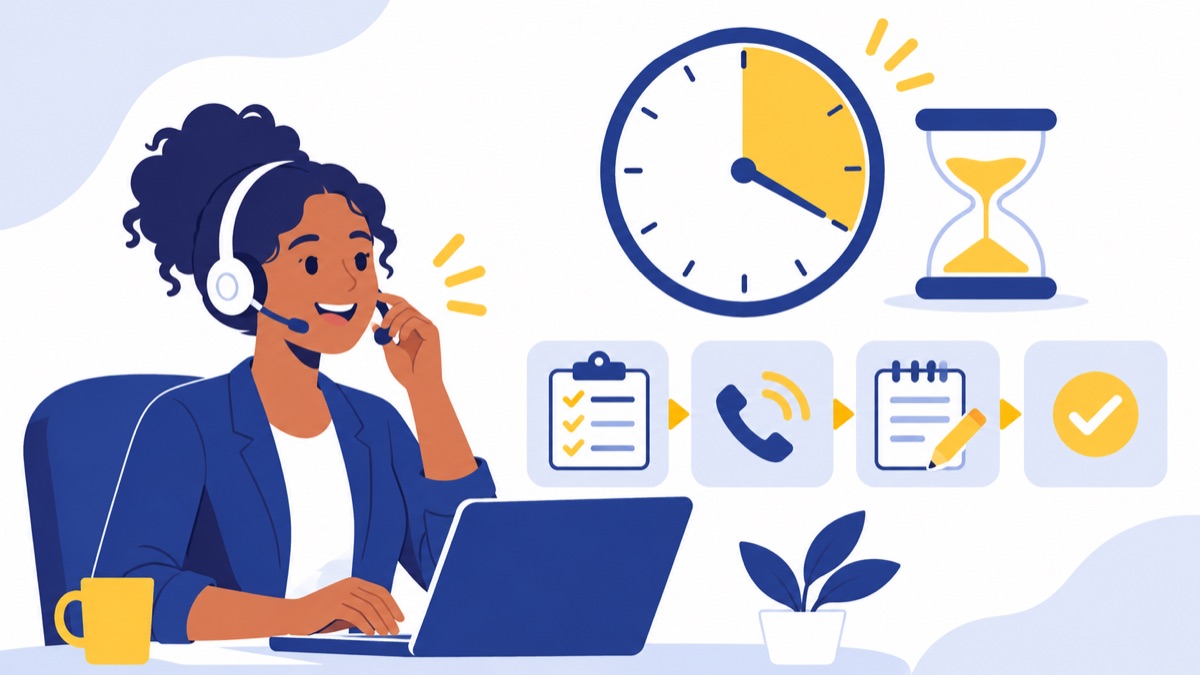
A practical cold calling schedule for sales reps gives list prep, dialing, notes, breaks, and follow-up their own places in a focused 90-minute block. Use the template below as a starting point, then adjust call windows and dialing targets using your team’s connect, conversation, and meeting rates. The goal is consistent, useful prospecting—not a universal quota.
Key takeaways
- A 90-minute sales call block can reserve 10 minutes for setup, 50 minutes for two dialing runs, and dedicated time for notes, follow-up, callbacks, and review.
- Reps should prepare a prioritized list, confirm prospect time zones, and have their talk track and CRM ready before dialing.
- Manual dialing fits small, highly researched lists; a power dialer can reduce between-call friction on larger, queued lists.
- Teams should measure connects, conversations, qualified outcomes, and meetings alongside dials to see where prospects drop out.
- US calling rules depend on call type, technology, and jurisdiction; teams should honor do-not-call requests and check applicable federal and state requirements.
What should a productive cold-calling block accomplish?
A productive cold-calling block protects time for live outreach while making room to record outcomes and schedule next steps. Use the 90-minute plan as a repeatable starting point, not a quota: list quality, connect rates, call length, role, and dialing method all affect how many prospects a rep can reach.
A sales call block is a scheduled stretch of focused time devoted to outbound calls and the work immediately surrounding them. A defined block limits distractions and helps managers compare results across similar sessions.
Judge the block by the quality and progression of conversations, not just by dials. HubSpot’s 2025 survey of 379 sales professionals found that 22% said cold calling was a major part of their daily activities, while another 22% called regularly but not daily—survey results that show how much calling varies across roles and teams (HubSpot’s 2025 State of Cold Calling).
Define success beyond raw dial count
Use the same definitions each time so reps and managers can compare results:
- Dials: Outbound call attempts.
- Connects: Calls answered by a person.
- Conversations: Connects that progress beyond a greeting or quick refusal.
- Qualified outcomes: Conversations that meet your team’s criteria for a relevant prospect or need.
- Meetings: Meetings booked during or as a result of the block.
- Follow-up completion: Promised next steps recorded and completed by their due date.
What is a practical 90-minute cold-calling schedule for sales reps?
This timed cold calling schedule for sales reps gives dialing two focused runs while reserving time for notes, breaks, and follow-up. Keep the live runs focused, capture a brief outcome after each call, and use the dedicated admin window to finish CRM details and queue next actions.
| Time | Activity | Completion cue |
|---|---|---|
| 0–10 min | Prepare the list and tools | Prioritized prospects queued; CRM and talk track open |
| 10–35 min | Dial the first batch | Each attempt has a disposition and next action |
| 35–40 min | Take a short reset | Stand, drink water, and return ready to dial |
| 40–65 min | Dial the second batch | Complete the planned batch and capture call outcomes |
| 65–75 min | Finish notes and queue follow-ups | CRM records are complete; promised next steps have owners and due dates |
| 75–85 min | Dial priority callbacks or next-best prospects | Callbacks are attempted; unused time goes to the next prioritized prospect |
| 85–90 min | Review results and set the next block | Record the funnel metrics and note one adjustment to consider |
During each dialing run, keep call notes short: record the disposition and a clear next action immediately. Save fuller notes for the 10-minute admin window, but do not leave an important commitment—such as a requested callback or meeting—unrecorded until later.
How can reps prepare without over-researching?
Reps can prepare efficiently by batching list research before the block and bringing one relevant personalization cue per prospect into the call. Confirm the target segment, contact details, and local time zone, then prioritize the queue so each run can begin without switching tasks.

Before the block, check that:
- The prospect list matches the intended industry, role, and campaign.
- Phone numbers and time zones have been checked.
- Prospects are prioritized by fit, urgency, or a useful trigger.
- A concise talk track and a few objection prompts are ready.
- The CRM is open and the right call dispositions are available.
Batch deeper research ahead of the scheduled call block instead of pausing to investigate every prospect while dialing. For each queued prospect, keep a small cue such as a role-specific challenge, company initiative, or reason for reaching out. HubSpot reported that 55% of regular cold callers surveyed cited a personalized, research-driven approach among the techniques that had given them the best results in the past year (HubSpot’s survey findings).
Should SDRs dial manually or use a power dialer?
Manual dialing is usually a better fit for a small list that needs careful research and tailored outreach; a power dialer may suit a larger, queued list where reps benefit from less between-call friction. Decide based on list size, personalization needs, expected call volume, CRM workflow, and the compliance requirements for your call type and dialer settings.
A power dialer is a tool that automatically places the next call from a prepared list when a rep is ready. It can help keep a high-volume workflow moving, but the right setup depends on how calls are initiated and what controls your team needs.
| Consideration | Manual dialing | Power dialer |
|---|---|---|
| List size | Small or carefully selected | Larger, prioritized queue |
| Personalization | More time to review each prospect | Works best with prep completed before the block |
| Call volume | Lower or variable | Higher potential throughput, depending on connects and talk time |
| Workflow | Rep starts and logs each call | May reduce between-call steps and support CRM logging |
| Compliance | Rep controls each attempt | Campaign configuration and dialing mode need review |
A simple rule: if reps need to study each prospect immediately before calling, start manually. If the list is ready and reps spend substantial time clicking between calls, consider a dialer pilot and compare the full funnel—not just attempts.
Voicalyst offers a power dialer for queued outreach, AI call summaries, and a HubSpot calling integration that can support parts of this workflow. Check that the selected dialing mode, campaign setup, and recordkeeping match your team’s compliance needs. For a fuller comparison, see how to choose between a power dialer and an auto dialer.
How should reps handle each call during the block?
A consistent call workflow helps reps start clearly, listen for relevance, and leave every attempt with an accurate outcome. State who you are and why you are calling, ask one focused question, and record the disposition and next action before moving on.

Keep the opening short and specific. For example: “Hi, Morgan—this is Alex with [company]. I’m calling because we help [type of team] with [relevant problem]. Is improving [specific process] on your radar this quarter?” Use the prospect’s response to decide whether to ask a follow-up, suggest a meeting, or end politely.
Use consistent dispositions such as:
- No answer: No person reached; follow your team’s callback policy.
- Connected: A person answered; add a more specific outcome if possible.
- Callback requested: Record the requested date and time in the prospect’s local time.
- Meeting booked: Save the meeting details and any agreed next steps.
- Do not call: Record the request promptly and follow the applicable suppression process.
How can teams measure and improve a call block?
Teams can improve a call block by tracking each stage from attempt to follow-up, then finding where prospects stop progressing. Review results across comparable blocks and change one part of the workflow at a time so the team can see whether the adjustment helped.
Calculate rates with clear denominators:
- Connect rate: Connects ÷ dials.
- Conversation rate: Conversations ÷ connects.
- Qualification rate: Qualified outcomes ÷ conversations.
- Meeting rate: Meetings ÷ conversations, or another consistently defined denominator.
- Follow-up completion rate: Follow-ups completed on time ÷ follow-ups due.
A low connect rate may point to list quality, phone-number accuracy, or calling windows. If reps connect but rarely have meaningful conversations, review the opening and prospect fit. If conversations happen but few meetings result, examine qualification and the meeting ask. For practical ways to improve reach, see this call connect rate playbook.
Treat external benchmarks as context, not quotas. HubSpot’s survey of respondents who said cold calling was a major part of their daily work found that 22% reported making 100–200 cold calls per week, while 12% reported more than 200; those self-reported ranges vary by role and organization (HubSpot’s 2025 report). Compare your own results by prospect segment, time zone, and call window over multiple blocks. Use published timing guidance as a starting point, then keep the windows that produce stronger connect and meeting rates for your audience.
What should US sales teams know about cold-calling rules?
US sales teams should schedule calls in the prospect’s local time, honor do-not-call requests, and check which federal and state rules apply to their call type and dialing technology. A single calling-hours rule does not resolve every question about B2B calls, consent, automated dialing, or state requirements.
The FTC says outbound telemarketing calls to a person’s home generally may not be made before 8 a.m. or after 9 p.m. in the called person’s local time, unless the person consented to different hours (FTC Telemarketing Sales Rule guidance). The rule concerns calls to a person’s home; do not treat it as a complete answer for every business call or jurisdiction.
The FTC also explains that predictive dialers can cause abandoned calls when a consumer answers and no representative is available. Its Telemarketing Sales Rule safe harbor includes an abandonment rate no higher than 3% of answered calls, along with other conditions (FTC guidance). Review the rules that apply to your campaign and states, and consult qualified counsel when needed. For a practical starting checklist, read TCPA compliance for sales calls.
Frequently Asked Questions
How many calls fit in a 90-minute block?
The number depends on your dialing method, connect rate, conversation length, and note-taking workflow. Track dials alongside connects, conversations, qualified outcomes, and meetings for several comparable blocks. Use your own results to set a realistic target; a raw dial count alone does not show whether the block is working.
What time should SDRs call prospects?
Start by scheduling calls during the prospect’s local business hours, then test different windows by segment and time zone. Published timing advice can suggest a starting point, but your team’s connect and meeting rates are more useful for choosing a recurring window. Compare similar prospects across multiple blocks before changing the schedule.
How long should reps spend on notes?
Capture a short disposition and next action right after each call so the record stays useful. Reserve the schedule’s 10-minute admin window for completing CRM notes and follow-ups. The right amount of detail depends on the conversation, but routine no-answers should take less time to log than a qualified conversation.
How often should teams change their call schedule?
Review results weekly, but avoid changing the schedule after one unusual block. Compare multiple blocks using similar prospect segments and local-time windows, then adjust one variable at a time—such as call timing, list priority, or dialing method. Keep the new schedule long enough to gather comparable results.
For a broader US schedule, see the hour-by-hour cold calling plan for SDRs. To see how Voicalyst can support a sales team’s calling workflow, visit Voicalyst.